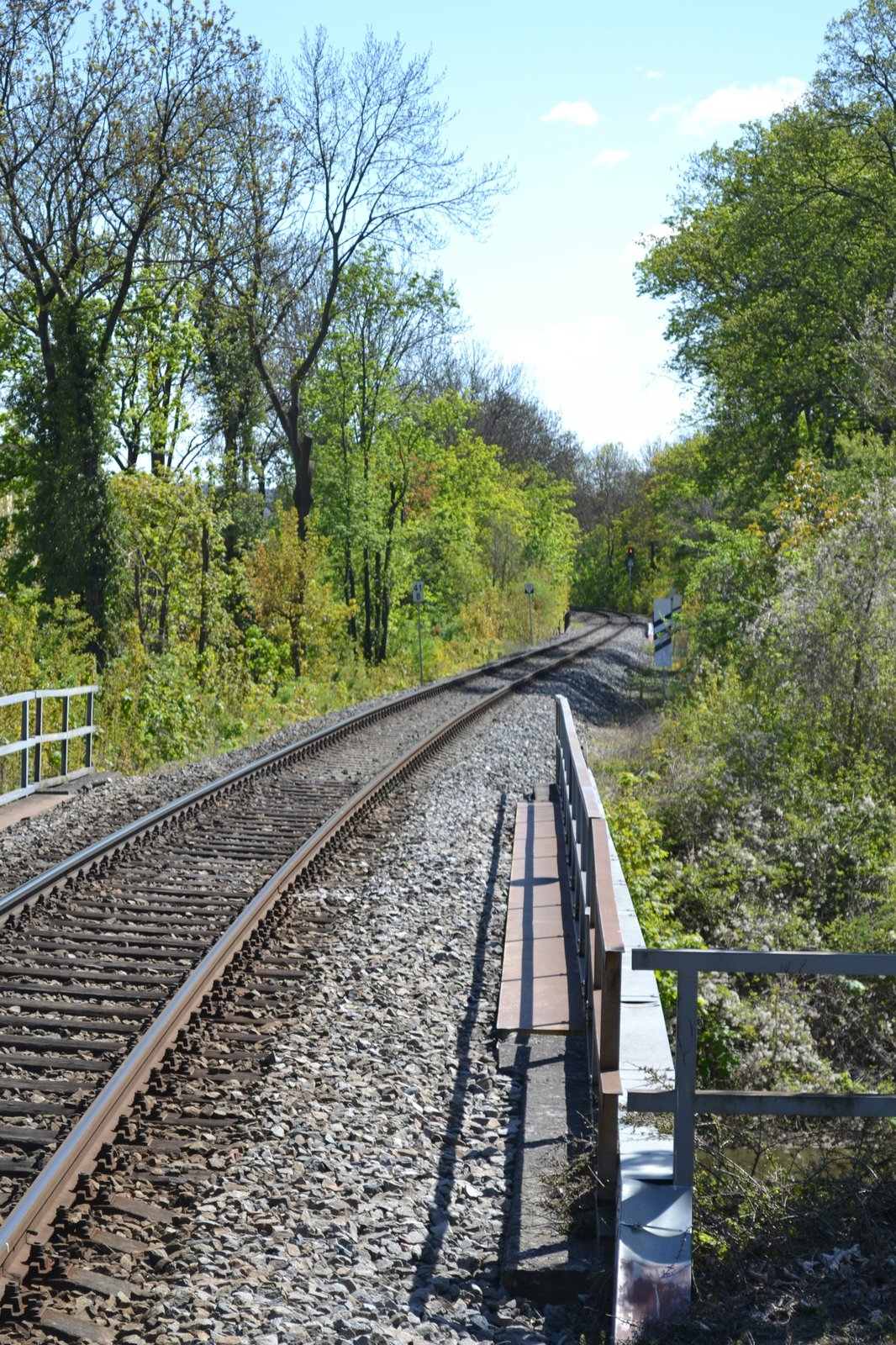
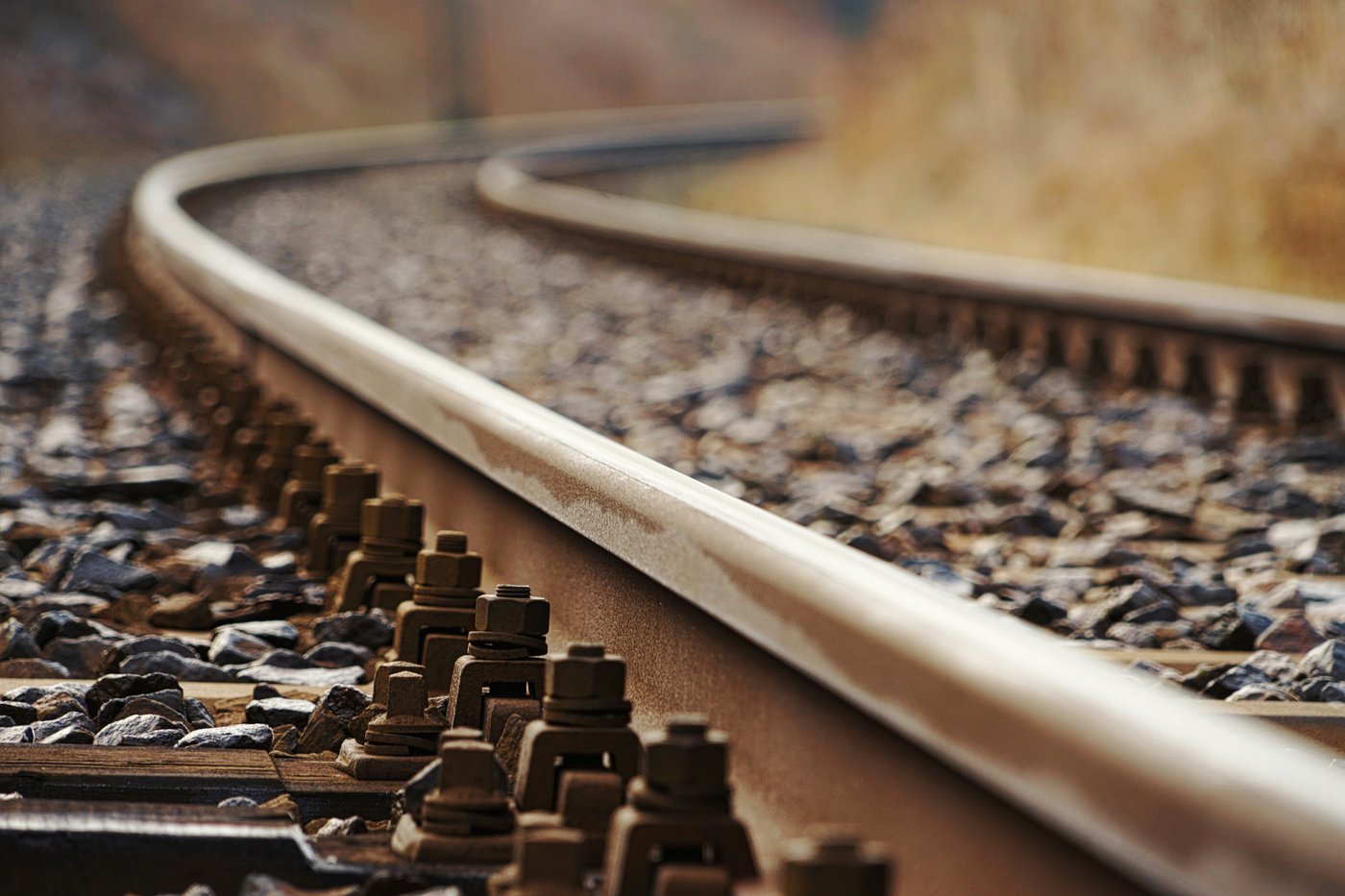
There railway superelevation This is the reason why, on curves, the outer rail is higher than the inner one. It's not an aesthetic detail: it's the way the track "leans" the train to counteract centrifugal force, like a cyclist leaning into a curve. The problem is that you can't compensate for everything for all trains: from this compromise arise two quantities that govern the geometry of the track—the equilibrium superelevation and the’insufficient superelevation.
The equilibrium superelevation
Imagine a train traveling around a curve at constant speed. It is acted upon by its weight (vertical) and centrifugal force (horizontal, outward). By raising the outer rail by a certain amount, E, the track plane tilts and the resultant of the two forces can become perpendicular to the plane: in that condition the passenger does not feel lateral thrusts and the two rails are loaded equally. It is the equilibrium superelevation, and for standard gauge (1435 mm) the following applies:
E = 11.82 · V² / R (E in mm, V in km/h, R in meters)
The constant 11,82 It is not arbitrary: it includes the gravitational acceleration (g = 9.81 m/s²), the distance between the rail axles (about 1500 mm), and the conversion of units from m/s to km/h. The message of the formula is clear: equilibrium depends on the square of speed and the inverse of the radius. Tight curves and high speeds require enormous superelevation—often impossible.
Because you can't compensate for everything
The superelevation has a practical ceiling: if a slow (or stationary) train is on a very steep curve, the load shifts entirely onto the inside rail and the passengers "fall" towards the centre. For this reason the regulations set a maximum superelevation around the 150–160 mm on ordinary and high-speed lines. But a curve is traveled by different trains at different speeds: a freight train at 90 km/h and an intercity train at 160 km/h cannot both be in equilibrium. The actual superelevation is therefore a compromise, set to an intermediate speed.
Whoever goes faster than the equilibrium "feels" a share of uncompensated centrifugal force: it is the“insufficient superelevation (D, cant deficiency). The fundamental relationship holds E_eq = E + D, where E_eq is the equilibrium superelevation, E is the one actually achieved and D is the missing part, which the traveler perceives as transverse acceleration. Those who go slower have a excess cant (D negative): typical of freight trains on mixed lines.
A deficiency of approximately 153 mm corresponds to an uncompensated transverse acceleration of approximately 1.0 m/s²: it is the limit of comfort and safety around which the rules revolve.
The limits of the EN 13803 standard
There EN 13803 — the European standard for the geometric design of tracks — establishes the permissible values. The applied superelevation typically remains within 160 mm (with lower values in the presence of switches or particular constraints). The cant deficiency has recommended limits around 130 mm, with exceptional values up to approximately 150–153 mm for ordinary material; tilting trains (pendolinos), which tilt the body, can go much further. The excess cant is normally kept within approximately 110 mm so as not to penalize slow trains.
A numerical example
Radius curve R = 1000 m traveled to V = 160 km/h. The equilibrium superelevation is E_eq = 11.82 · 160² / 1000 = 11.82 · 25,600 / 1000 ≈ 303 mm: unachievable, well beyond the 160 mm ceiling. Realizing the maximum elevation E = 160 mm, the insufficiency is D = 303 − 160 = 143 mm, within the exceptional limit. If the radius were to rise to 2000 m, the equilibrium would drop to approximately 236 mm and the insufficiency alone 76 mm: this is why fast lines require large radii.
A fact to be recorded precisely
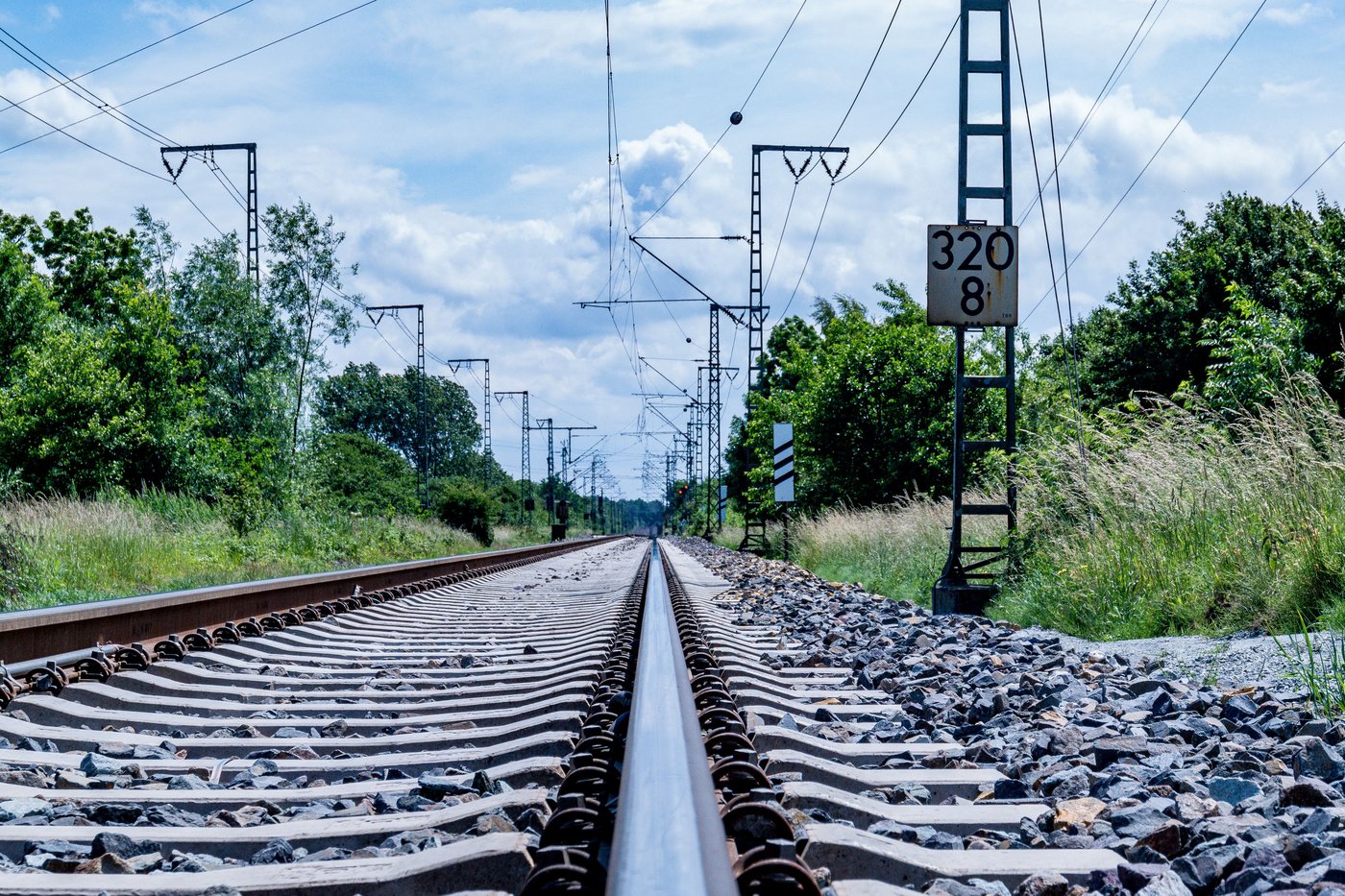
Superelevation, radius, and speed are linked by an equation that allows no approximations: a few millimeters of superelevation outside of tolerance, or an incorrectly measured radius, affect the perceived acceleration and the permitted speed limits. For this reason, the geometry of the curve—superelevation, direction of the connection, development of the clothoid—is among the quantities that track surveys must render with the greatest accuracy.
Sources:
Gareth Dennis — The cans and cants of railway curves;
Railway Track Blog — Where the 11.82 comes from;
EN 13803 — Cant and cant deficiency/excess limits (table);
Cant deficiency — technical summary note.