All of a train's mass—tens or hundreds of tons—is discharged onto the track through a few surfaces the size of a coin. Wheel-rail contact is the point where grip, cornering, wear, and comfort are all decided: understanding it means understanding why track wears and why trains "snake." Let's see how it works, with numbers.
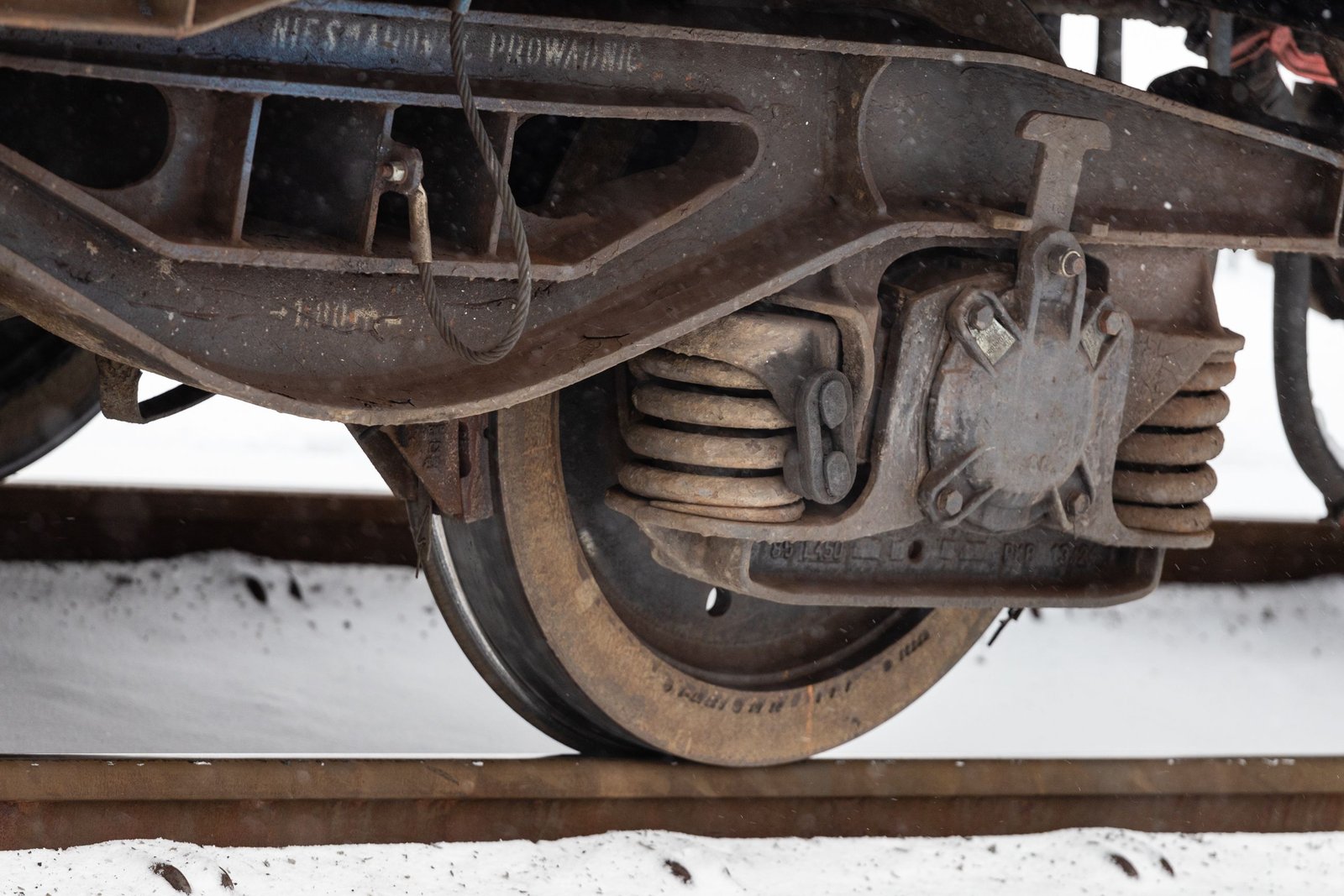
A contact ellipse as big as a coin
Wheel and rail are two curved steel bodies pressed against each other. The contact is not a point but a small surface, according to the theory of elastic contact formulated by Heinrich Hertz in 1882: two elastic solids touching each other create an elliptical imprint. In the case of railways, this ellipse typically measures about 14 x 11 mm, or an area of the order of 1–1.5 cm². That tiny surface bears the load of a wheel: with a 22.5-ton axle (the current limit on the European network), each wheel delivers approximately 110 kN.
Approximately 1-1.5 cm² of contact area and maximum pressures of the order of 1,000-1,500 MPa: stresses close to the limit of hardened steel are concentrated on the wheel-rail contact.
The result is extremely high contact pressure. The Hertzian distribution is elliptical, with a peak at the center of the footprint that in normal operation is 800-1,200 MPa for passenger traffic and exceeds 1,000 MPa for freight cars, with peaks of up to approximately 1,500 MPa in the most severe conditions. These values are close to the compressive strength of hardened steel: this is why rolling contact fatigue (RCF) and wear arise precisely here.
Not just pressure: creep forces
Hertz's theory describes the "normal" problem (pressure perpendicular to the surfaces), but the wheel must also transmit longitudinal (traction and braking) and transverse (cornering) forces. These forces arise from a controlled micro-slip within the footprint, called creep or relative sliding (creepage): the wheel does not slip as a whole, but the surfaces deform elastically and slide very slightly. The relationship between creepage and transmitted forces is described by J.J. Kalker's tangential contact theory, which forms the basis of the algorithms used today in vehicle dynamics (the simplified FASTSIM model and the CONTACT reference program). It is thanks to these creep forces that a train accelerates, brakes, and stays on track.
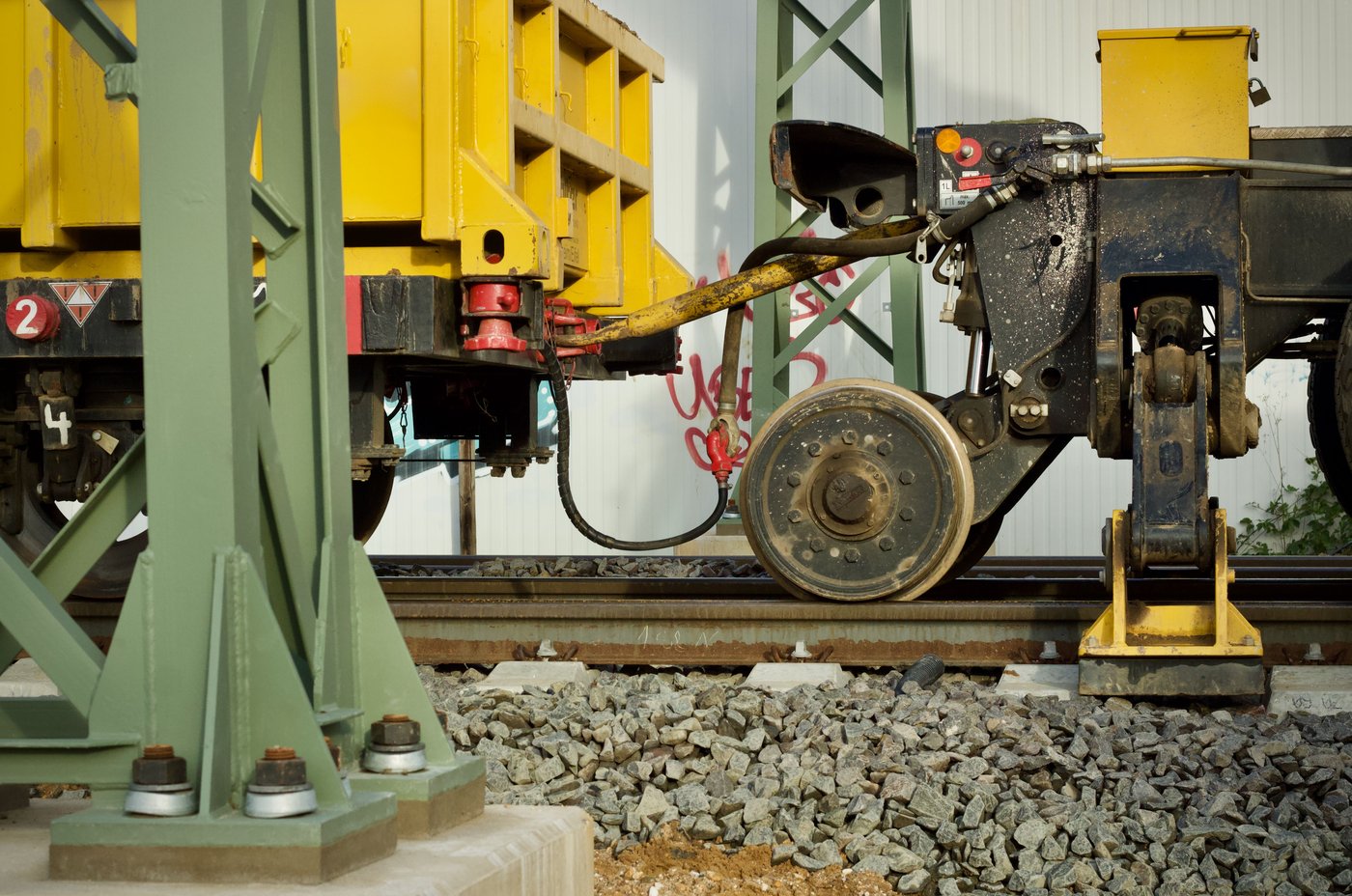
Conicity and meandering in the wheel-rail contact
The rim is not cylindrical but slightly conical. This conicity is what allows the wheelset (the two wheels keyed to a rigid axle) to self-center: if the wheelset moves laterally, the wheel on one side rolls on a larger diameter and the other on a smaller diameter; rotating at the same angular velocity, the wheelset tends to return towards the center of the track. This same mechanism, however, generates a sinusoidal oscillation, the meandering (hunting). Its kinematic wavelength is given by Klingel's formula (1883):
λ = 2π √(r e/γ) — with r the rolling radius, and semi-distance between the rolling circles, γ equivalent conicity. Example: r=0.46 m, e=0.75 m, γ=0.1 give λ ≈ 12 m.
Beyond a certain critical speed, the meandering no longer fades but amplifies, with vibrations that damage the track and the track and, in the extreme, risk derailment. For this reason, the equivalent taper It is a standardized safety parameter (calculation method in EN 15302) and depends on both the wheel profile (typically S1002 in Europe) and the rail profile (60E1/54E1) and its inclined installation (1:20 or 1:40). Checking the track geometry, profiles and wear means keeping the wheel-rail contact under control.
Sources: H. Hertz, “Über die Berührung fester elastischer Körper” (1882); J.J. Kalker, Theory of Rolling Contact (CONTACT/FASTSIM); Klingel's formula (1883); EN 15302 (equivalent conicity); S. Iwnicki (ed.), “Handbook of Railway Vehicle Dynamics”. Indicative values of contact area and pressure from technical literature; check design data in applicable standards.