Knowing with certainty whether a section of track is free or occupied is the foundation of railway safety. Alongside the traditional track circuit, the most widely used method today is the axle counter: instead of passing current through the rails, it counts the axles entering and exiting a section. If the same number of axles have entered as have exited, the section is free. Let's see how it works.
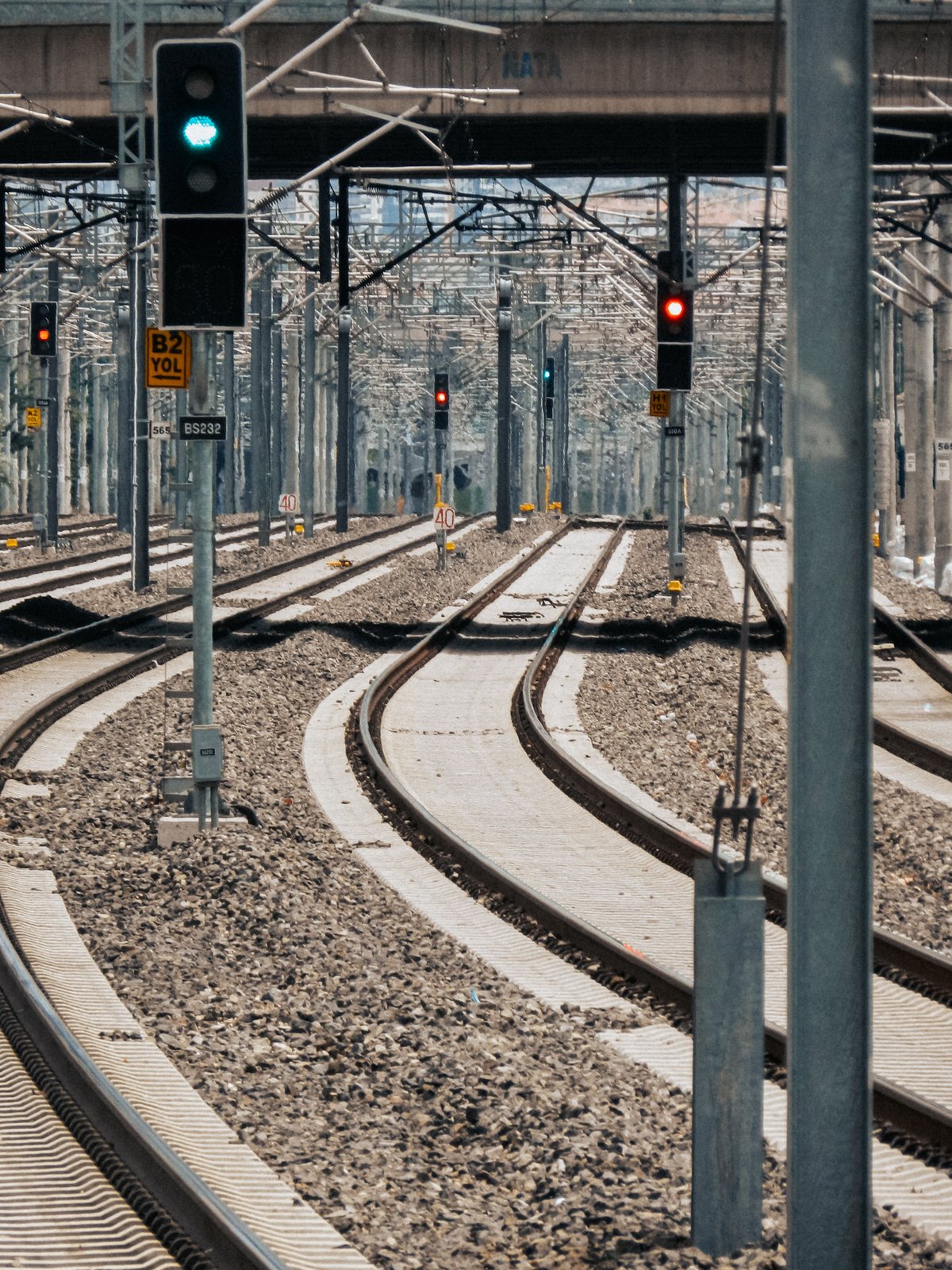
The wheel sensor: counting without touching
A counting head, a wheel sensor, is installed at both ends of the section to be monitored. The principle is electromagnetic-inductive: the sensor generates a field that interacts with the rail head; when the wheel flange (made of ferromagnetic steel) passes, it alters and dampens that field, producing an analog pulse. It is a contactless counting system: nothing is mechanically touched, and no signal current flows through the rail.
Each counting head integrates two sensors side by side: from the order and timing with which the edge passes through them, the system calculates the direction of travel and the speed, as well as the passage of the axis.
The logic: fewer people entered and fewer people left.
The heart of the system is the evaluation unit (in German Auswerter). Each time an axis enters the section, a counter is incremented; when an axis exits the other head, the counter is decremented. The direction is provided by the double sensor. The safety rule is simple and robust:
Net count = axles entered − axles exited. If the result is zero, the section is declared free; if it is non-zero, it is occupied. In case of doubt, the system maintains the "occupied" state (fail-safe principle).
The reset: when the system “forgets”
Since the axle counter relies on a memory, a power outage or disturbance can cause it to lose count. For this reason, there are reset procedures that return the section to the "free" state only under safe conditions: some require an entire train to pass through the section, others require coordination between a technician and a traffic officer. Resetting is never automatic, "blind": it restarts from a verified state, because mistakenly declaring an occupied section free would be dangerous.
Why is the axle counter used (and its limitations)
Compared to the track circuit, the axle counter does not require insulated joints or traction current return connections, is insensitive to rust and contamination of the ballast, and covers long sections, non-electrified sections, and metal bridges well. However, it has some limitations: it does not detect rail breaks (which the track circuit can detect) and requires a reset after a disturbance. To ensure proper operation, a "metal-free zone" around the wheels is required (no magnetic or eddy current brakes, no sandblasting in that area) to prevent false counts. The performance and interoperability of train detection systems are regulated at the European level by EN 50617 (part 2 dedicated to axle counters), and the devices are developed according to CENELEC safety standards, typically at the highest integrity level (SIL 4).

Sources: EN 50617-2 (technical parameters of train detection systems — axle counters); manufacturers' technical documentation (Frauscher, Siemens, Pintsch); "Axle counter" item. SIL levels and reset procedures according to CENELEC standards (EN 50126/50128/50129) and network operator regulations.
Related service: Railway superstructure design by P-WAY Engineering.