The Fehmarnbelt Tunnel It isn't excavated: it's assembled on the seabed, one piece at a time. When completed, its 18 kilometers under the Strait between Denmark and Germany will be the longest immersed road and rail tunnel in the world. The first of its enormous concrete elements was lowered to the seabed in May 2026.
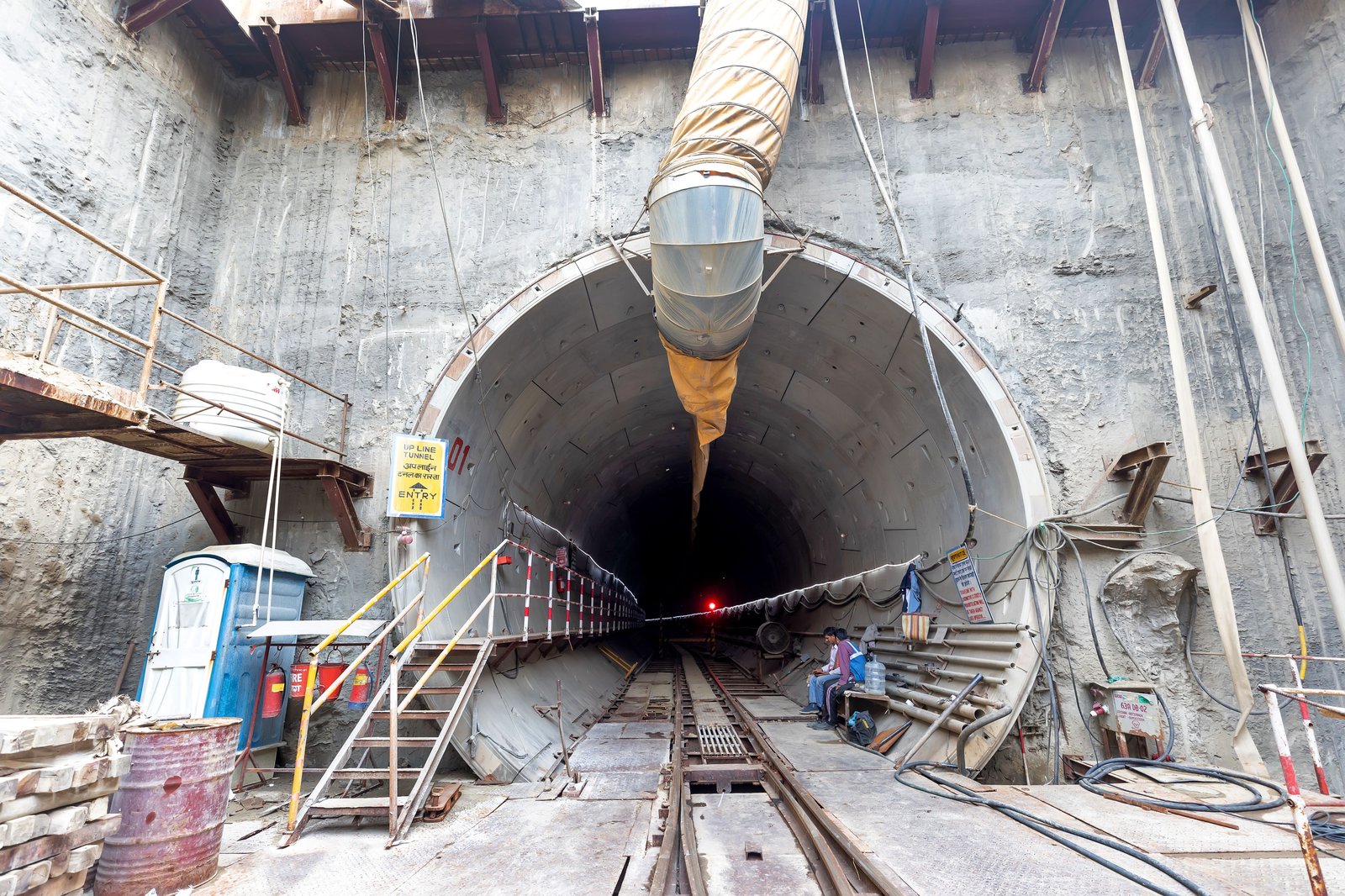
A tube resting on the seabed
Most underwater tunnels are dug with a tunnel boring machine (TBM) into the rock beneath the seabed. The Fehmarnbelt follows the opposite logic, that of the immersed tunnel: the elements are prefabricated on the ground in a factory, closed at the ends, towed floating to the installation point and finally lowered into a dredged trench on the seabed, where they are joined underwater and covered with gravel. The result is a tunnel that rests on the seabed rather than traversing it underground.
The technology is the same as that used on the Øresund between Denmark and Sweden, but here it has been scaled up to unprecedented levels. The production facility in Rødbyhavn, on the Danish side, covers an area equivalent to about 300 football fields: it is the largest in Europe, with over 2,000 employees from more than 40 countries and five parallel production lines.
Eighty-nine boxes of concrete
The tunnel is composed of 89 items: 79 standard elements and 10 special, smaller elements, which house the electrical and technical systems. Each standard element is 1.5 m long. 217 meters, is divided into nine segments and weighs over 73,500 tons —yet, sealed at the ends, it floats enough to be towed out to sea.
The section tells the double nature of the work: five pipes placed side by side, two for the highway (two lanes in each direction), two for the railway with double electrified track and a service gallery Central station for systems and escape routes. The railway will be accessible at 200 km/h.
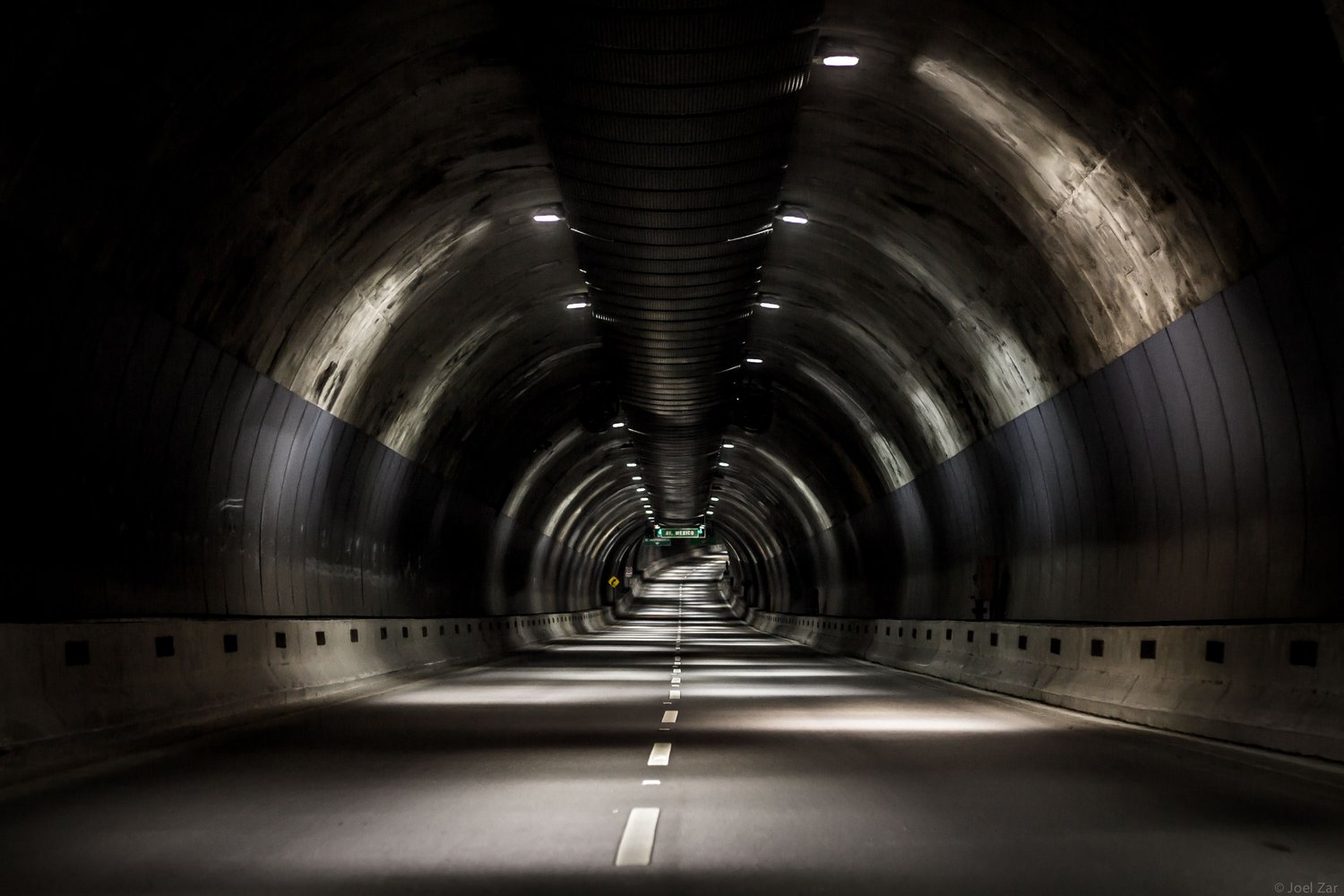
Fehmarnbelt numbers: 18 km of immersed tunnel, 89 prefabricated elements, in addition 73,500 t for standard element of 217 m, until 40 m deep below the surface of the sea, double electrified track 200 km/h plus four highway lanes, design life 120 years.
Drop 73,500 tons per millimeter
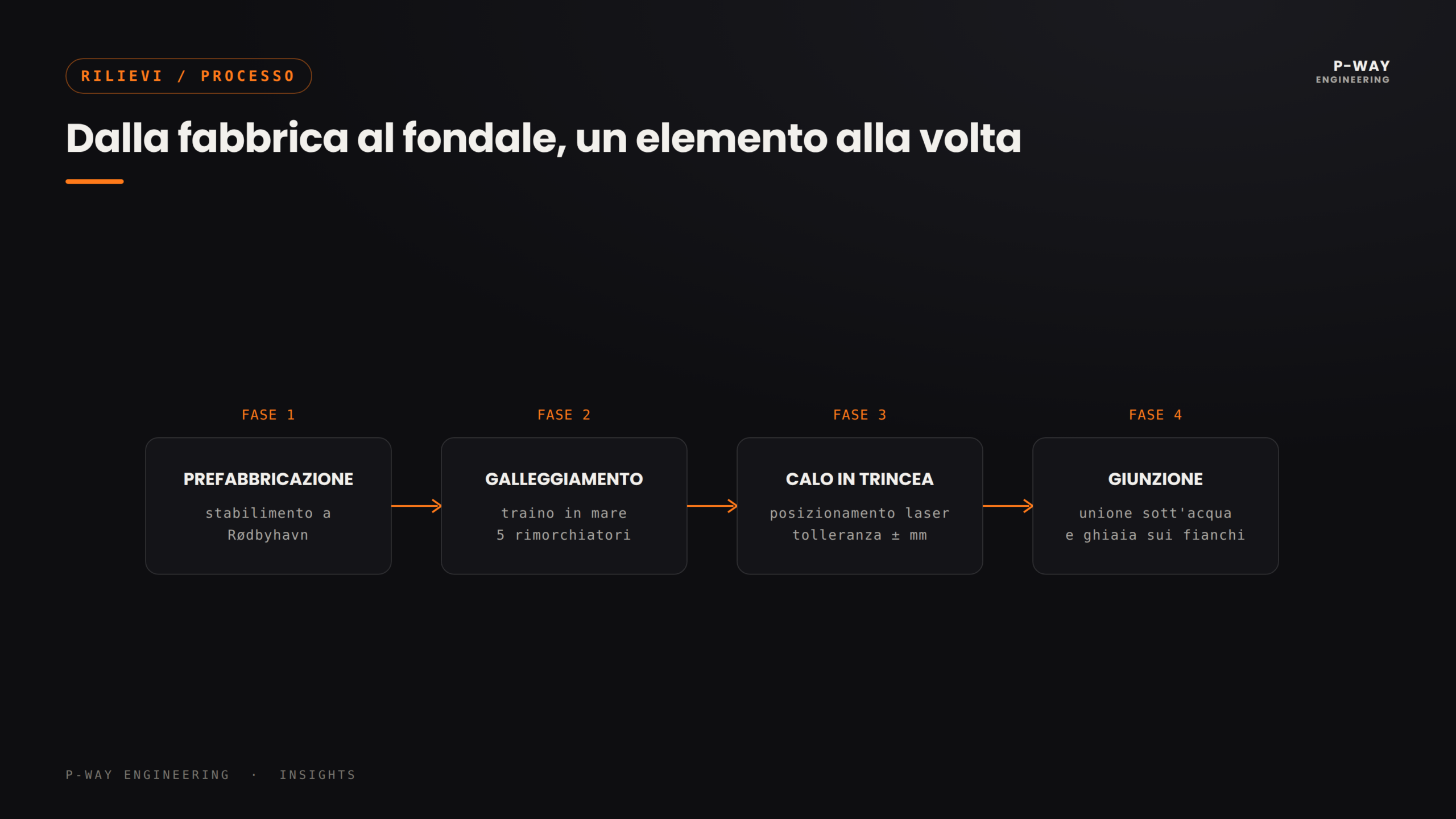
This is where the work becomes a challenge of precision. Each element is towed out to sea by five tugboats and the specialized vessel IVY to the installation point, then lowered into the trench with hydraulic arms. Positioning is controlled with laser measurements and must respect a tolerance of a few millimeters: only in this way will the joints between one element and the next remain watertight and the track alignment remain within the geometric limits required for 200 km/h travel. Once in position, the element is stabilized with gravel placed along its sides.
Everything rests on an accurate seabed survey and a precisely dredged route: the trench must follow the project axis and provide a laying plan within tight tolerances, because any deviations are cumulated over the 18 kilometers. It is the same discipline of surveying and geometric control that governs the verification of any shape or alignment, from the underwater trench to the limiting shape of a line.
Times, costs and corridor
Work began on January 1, 2021. The first element was lowered in May 2026; by the summer, three had been lowered off the Danish coast, while the Danish portal at Rødbyhavn was completed and the German one at Puttgarden was approximately 90%. The opening, initially scheduled for 2029, was postponed to 2031 due to construction delays.
The cost of the work is estimated at approximately 52.6 billion Danish kroner (just over 7.4 billion euros), to which Germany is adding approximately 800 million for motorway connections. The connection — built by the Danish state-owned company Femern A/S — will replace the 45-minute Scandlines ferry with a crossing of 7 minutes by train and 10 by car, and will cut the Hamburg–Copenhagen rail travel time from 4 hours and 40 minutes to around 2 hours and 30 minutes. It is a piece of the Scandinavian-Mediterranean TEN-T corridor, the axis that links Scandinavia to continental Europe.
Sources: Femern A/S — Project status; Tunneling Online — First element of the Fehmarnbelt tunnel successfully immersed (May 2026); Fehmarn Belt fixed link — Wikipedia; Femern Belt Development — Fehmarn project challenged: difficult to reach opening in 2029; Engineering News-Record — World's Longest Immersed Tunnel Passes Milestone, But Faces Delays.