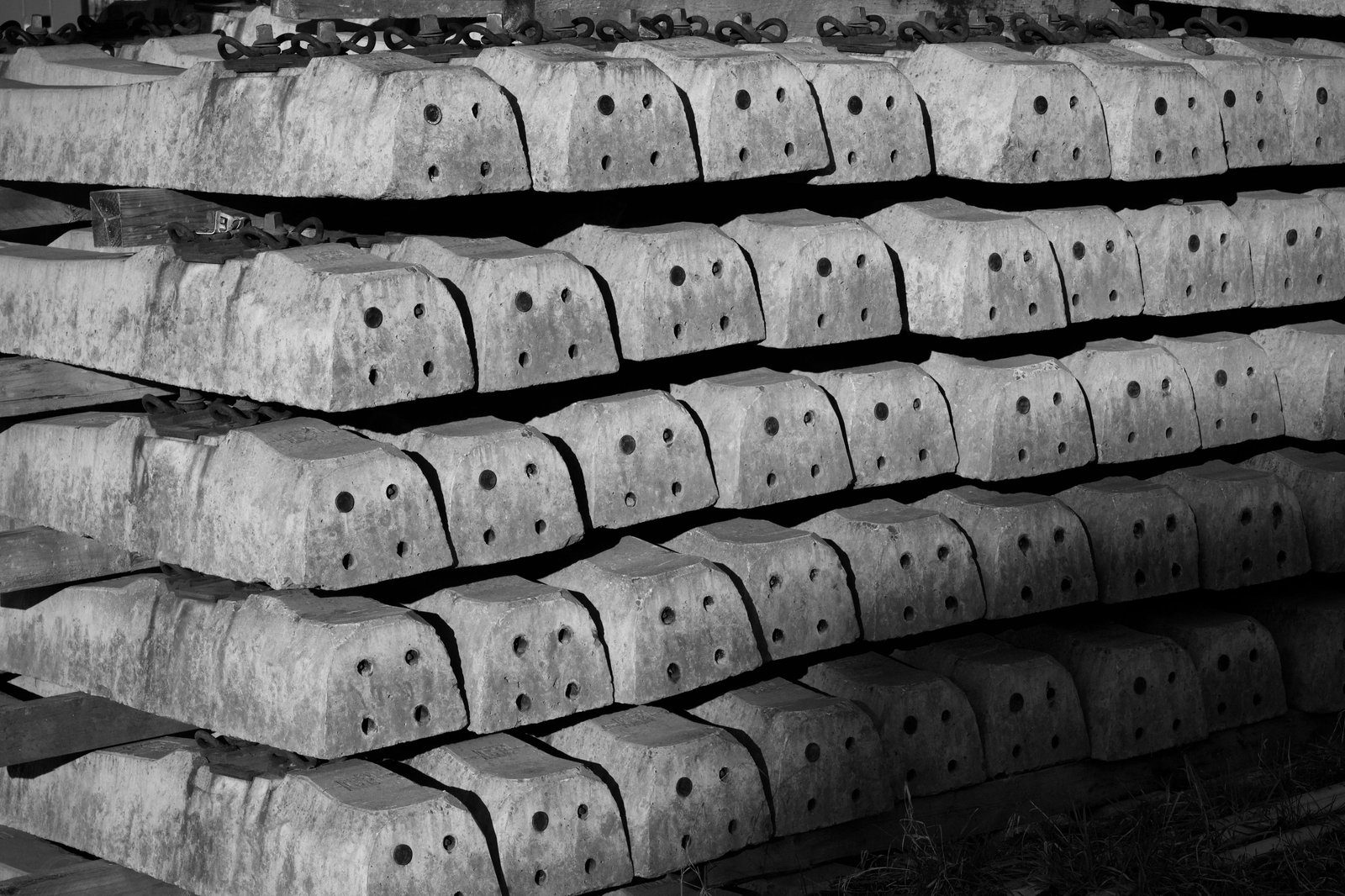
Under each meter of track there are, on average, little more than one and a half elements per meter that no one notices as long as it is working: the sleeper. prestressed concrete sleepers They have progressively replaced wood on high-traffic lines, and the reason lies entirely in a design idea — to make the concrete work only where it knows how to work, that is, in compression.
What a crosspiece should do
The crosspiece performs several functions at the same time. It maintains the gauge constant between the two rails; transmits to the ballast the vertical, lateral and longitudinal loads it receives from the attachments; distributes the pressure over a surface large enough not to puncture the ballast; and guarantees the’electrical insulation between the two rails, an essential condition for the functioning of the track circuits for train detection, which also depends on the insulating quality of the sleepers and fastenings.
Monobloc, bibloc, wood: masses compared
There are three large families. The crossroads monoblock pre-stressed reinforced concrete is now the standard on main lines: a single body that typically weighs between 250 and 320 kg. The crossroads bibloc It is made up of two concrete blocks (approximately 90 kg each, ~180 kg overall) joined by a metal crosspiece, which absorbs the bending stress in the centre. The crosspiece in wood, lighter (80–100 kg) and still irreplaceable in some contexts such as switches, however it has a shorter lifespan.
A concrete sleeper is designed for a service life of over 50 years, against the 20–30 years typical of the treated wooden sleeper: this is the main economic reason for its diffusion on high-traffic lines.

Why "prestressed"«
Concrete resists compression well but tension poorly: under bending, it tends to crack at the taut edge. Prestressing solves the problem at its root. Before pouring, high-strength steel wires or strands are stretched inside the formwork; the concrete is poured around them, and once it hardens, the wires are released. The steel, as it shortens again, transfers a state of tension to the concrete. permanent compression.
The result is that, when the passage of the train induces bending, the sleeper never enters net tension: the prestressing compression "covers" the operating tensile stress, and the cross-section remains intact without cracking. It's the same principle used to compress a row of books and lift them by their ends.

Geometry and dimensioning according to EN 13230
The design of the monoblock crosspiece is regulated in Europe by the standard EN 13230 (effective from October 2002; Part 2 concerns prestressed monoblock sleepers), with UIC design guide 713. Typical dimensions of a 60E1 rail sleeper are a length of 2.5–2.7 m, a rail seat width of approximately 150 mm and a height under the rail of the order of 233 mm. The distance between crosspieces in the current line is normally 600–650 mm (of the order of 1,500–1,660 sleepers per kilometre), and drops towards 550–600 mm on high-speed lines and on large works – such as the tunnels of the Mont Cenis Base Tunnel — where the number per km increases correspondingly.
In terms of loads, EN 13230 refers to a design load per wheel of the order of 280 kN, with certification tests that can go up to 440 kN axial load. The sizing checks the bending moments at two critical points: positive at the rail support (indicatively 28.6–43.3 kNm in the example at 347 kN of axial load) and negative at the centre of the crosspiece (of the order of 24.7 kNm), where the cross-section is often tapered "for life". The design life assumed by the standard is 40 years, with actual service lives much longer.
Sources: Global Railway Review – Design of Prestressed Concrete Sleepers; BSI – EN 13230 Concrete sleepers and bearers; Railway News – Railway sleepers: concrete vs. wood.